



🔥 Introduction — The B2B Marketing Shift No One Can Ignore
A decade ago, B2B marketing was straightforward — email blasts, trade shows, cold calls, gated PDFs, and a CRM full of unqualified leads. It worked because buyers tolerated it.
But 2025 onwards? The game is fundamentally different.
Decision-makers today evaluate vendors like consumers.
They expect:
- Content tailored to their business case
- Personalized outreach based on their pain points
- Instant answers, not 10 follow-ups
- Proof, not promises
In fact, 71% of B2B buyers expect personalized interactions, and 76% get frustrated when messaging feels generic or irrelevant (McKinsey Research). The era of spray-and-pray marketing is over — replaced by intent-driven, AI-powered personalization at scale.
This isn’t just evolution. It’s a tectonic shift in how businesses win attention, generate trust, and close deals.
And AI sits at the center of it.
🚀 Why AI Is the Future of B2B Marketing
1. B2B buying is complex — AI simplifies decisions
Multiple stakeholders. Lengthy cycles. Technical evaluation. Budget approvals.
AI bridges complexity with clarity.
- It analyzes buyer behavior patterns
- Predicts intent signals
- Recommends personalized content pathways
Think Netflix-style personalization, but for enterprise buyers evaluating a SaaS tool or a cybersecurity partner.
2. AI enables personalization at scale, not manually
Personalization used to mean:
“Hi <Name>, saw your profile — thought you’d be interested.”
Now it means:
🔹 Identifying industry problems before outreach
🔹 Mapping solutions to company tech stacks
🔹 Delivering ROI-specific content tailored to their maturity
AI makes this scalable for thousands of accounts simultaneously — something humans cannot do alone.
3. Data becomes the new marketing currency
The brands that will dominate B2B are the ones who train AI models on:
- CRM data
- Engagement behavior
- Website heat maps
- Sales call transcripts
- Purchase history
- Industry benchmarks
AI doesn’t just automate. It learns.
Soon, companies will compete on who personalizes better, not who advertises more.
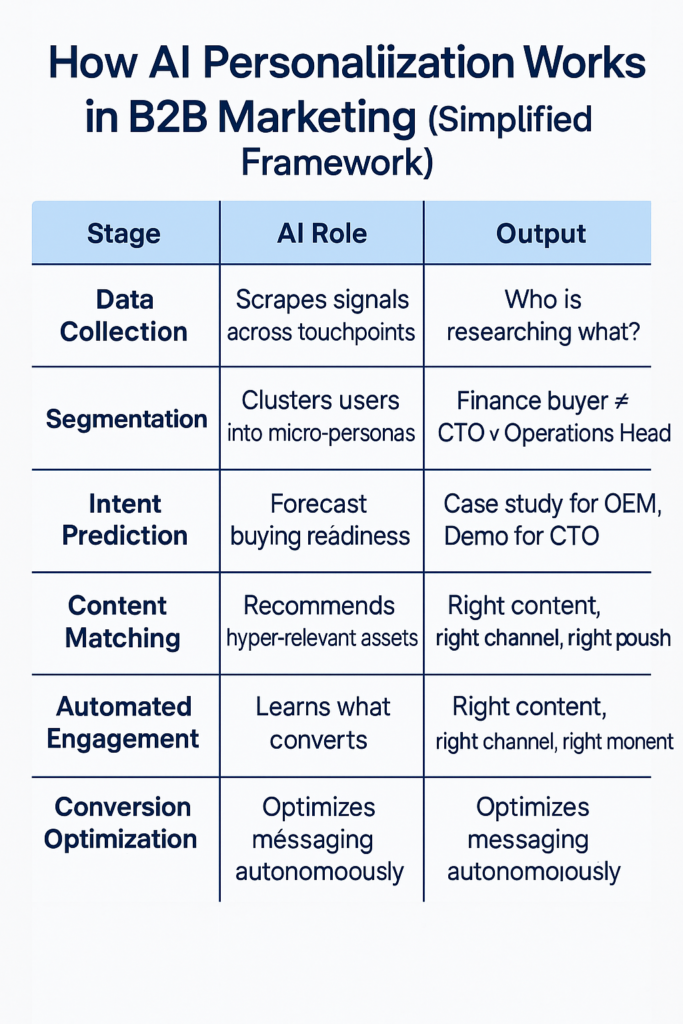
📈 Real-World Use Cases — From Theory to Execution
◎ Use Case 1: AI-crafted Outreach for Enterprise Leads
Sales teams feed AI:
- ICP (ideal customer profile)
- Company info
- Previous conversations
- Pain points
AI generates:
✓ Personalized mails
✓ ROI-focused pitch decks
✓ Objection handling scripts
Imagine outreach that feels like it was handcrafted — but was auto-generated at scale.
◎ Use Case 2: Website Auto-Personalization
A CTO visits your site → sees technical whitepapers & integration docs.
A Procurement Head visits → sees pricing calculators & vendor comparison sheets.
Same website. Different experience.
Powered by adaptive content systems.
◎ Use Case 3: Predictive Lead Scoring
Instead of Excel scoring, AI evaluates:
- Engagement depth
- Research activity
- Industry urgency
- Budget signals
High-intent accounts surface instantly → sales velocity accelerates.
◎ Use Case 4: AI-generated Dynamic Ads for B2B
Instead of one ad per campaign, AI creates hundreds of variations based on:
Industry | Persona | Pain Point | Funnel Stage
Meta + LinkedIn B2B AI campaigns are showing 2.5x higher CTR on personalized variants.
🧠 Human + AI > AI Alone
AI personalizes at scale, but humans inject:
- Empathy
- Creativity
- Strategic direction
- Relationship building
The winners will be marketers who use AI as a co-pilot, not a replacement.
Future teams look like:
AI Researcher + Data Analyst + Content Strategist + Human Storyteller + Sales Intelligence
Not just “copywriter + designer.”
🔮 What the Next 5 Years Look Like in B2B AI Marketing
1. Hyper-personalized buying journeys
Every buyer gets a unique path — like fingerprints.
No two nurturing flows look the same.
2. AI SDRs & Virtual Sales Assistants
AI will:
- Respond to leads instantly
- Ask qualification questions
- Book meetings automatically
Human sales reps enter only at later stages.
3. Autonomous ABM Campaigns
Give AI:
- ICP + goals + offers
And it builds the campaign, creatives, and targeting itself.
We’re already seeing early versions with HubSpot AI, Adobe Sensei, Apollo AI.
4. AI-powered Content Factories
Your blog, whitepaper, email, SEO cluster — created in minutes.
But the edge won’t be creation.
It will be strategy + originality + thought leadership.
5. Emotion-aware AI
Future AI will analyze sentiment & adapt tone live.
Imagine AI rewriting pitch tone based on CFO’s message mood.
🏆 What Companies Need to Do Now
✔ Invest in first-party data
Privacy laws are killing third-party cookies.
Own your data or lose personalization power.
✔ Build modular content
Long form → micro assets for multiple personas.
✔ Train internal teams for AI adoption
Skill shift is inevitable.
Writers learn prompt engineering.
Sales learns AI follow-ups.
Marketing becomes data-driven.
✔ Start small but start now
Use AI for:
- Email personalization
- Content repurposing
- Lead scoring
- Chatbots
- ABM campaigns
The cost of adopting early < risk of adopting late.
FAQs (SEO Boost)
Q1: Will AI replace B2B marketers?
No — it will replace marketers who don’t use AI.
Human strategy + AI execution = future-proof.
Q2: Is personalization relevant for small B2B businesses?
Absolutely. Even SMB buyers expect tailored messaging.
AI makes personalization affordable.
Q3: How to start with AI personalization?
Begin with CRM integration, email personalization engines, and intent-based content automation.
Conclusion — The Future Belongs to the Personalized
AI isn’t just enhancing B2B marketing — it’s redefining it.
Buyers don’t want more information.
They want the right information, at the right moment, in their language.
Brands that embrace personalization now will lead the next decade.
Those who don’t — will compete on price instead of value.