



🧨 The Harsh Truth: Clicks Are the New Bottleneck
For decades, enterprises have measured productivity by how quickly employees could navigate screens, menus and tools.
Click → open menu → fetch report → trigger workflow → export file → mail to manager.
It worked when business velocity was measured in quarters.
Today, business velocity is measured in real-time, and click-driven workflows simply cannot keep up.
While traditional systems wait for humans to trigger actions, AI-first enterprises run on autonomous execution.
Where humans used to click, scroll, select, approve — AI now predicts, decides, and acts.
If your workforce still relies on task execution through menus and dashboards, then whether you see it yet or not:
You’re competing against organizations that don’t need humans to click to get work done.
And they will move faster than you — every single day.
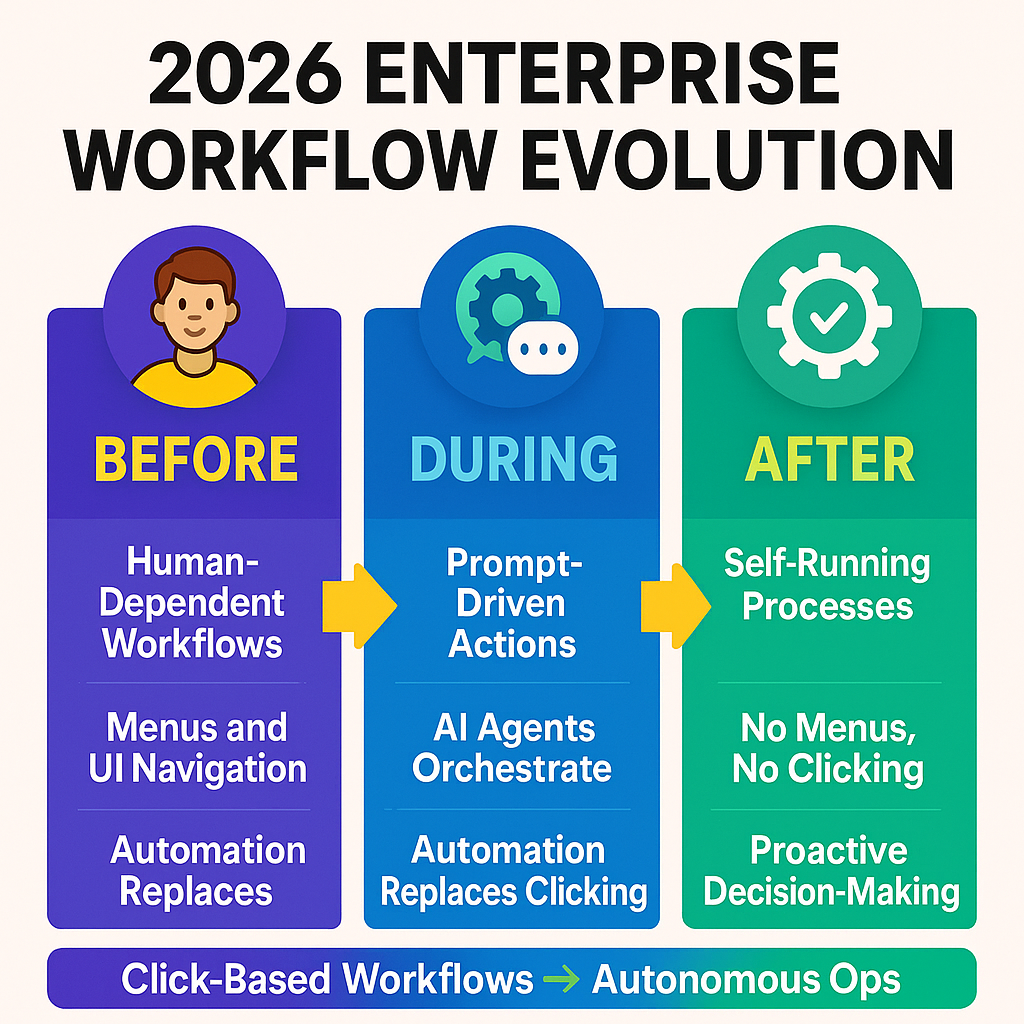
📉 Click-Based Workflows = Slow, Manual, Reactive
Click systems assume:
- Humans initiate workflows
- Humans fetch data to decide
- Humans perform repetitive actions
- Humans resolve failures manually
This model collapses at modern scale.
In 2024 alone, an average enterprise employee performed an estimated 1.1M clicks per year, according to internal time-tracking studies across Fortune 500 workflow teams.
Every click is friction.
Friction = cost.
Cost = inefficiency and lost competitiveness.
Meanwhile, AI-automated workplaces run on intent, not interaction.
🚀 The New Paradigm: Prompt-Driven, AI-Orchestrated Systems
The future belongs to enterprises where:
- Employees ask, and systems do
- Processes run themselves
- Reports generate automatically
- Incidents self-diagnose
- Code, drafts, documents auto-produce
Work isn’t clicked, it’s commanded.
From click-based → action-based → autonomous-based.
Example:
Traditional CRM workflow:
Click → filter → export → email → update notes.
AI-CRM workflow:
“Summarize this quarter’s top churn-risk accounts and notify account owners with playbooks.”
Done in seconds, no UI navigation.
Why Enterprises Behind on This Will Struggle by 2026
1. Productivity gap will widen exponentially
AI-native teams operate 3-10x faster.
Click-based teams will never catch up.
2. Decision cycles will be too slow
In markets where milliseconds decide algorithmic bids, clicks are prehistoric.
3. Cost per outcome will be significantly higher
More workers are required to produce the same outputs.
4. Talent will prefer automation-first employers
Nobody wants to spend their career clicking buttons like a machine.
5. Competitors using agent-automation will eat your market share
Not by doing better work — by doing work faster than you can respond.
🧠 What Replaces Click Systems?
AI Agents + Prompt Workflows + Autonomous Operations
Think of it like upgrading from:
🖱 Clicking to run tasks
⬇
💬 Asking to run tasks
⬇
🧠 Tasks running by themselves
We’re transitioning from:
- UI → Voice/Prompt
- Menus → Intent
- Manual Ops → AIOps
- Operators → Orchestrators
Humans move up the value chain.
Machines move into execution.
🔥 Real Enterprise Use Cases Already Live
1. AIOps in Cloud Management
Auto-scale resources when traffic spikes.
No human opens dashboards to adjust load.
2. AI-Dev Tools
CI/CD pipelines trigger automatically when code changes.
AI reviews, tests and deploys.
3. AI in Customer Support
Bots resolve l1/l2 tickets without agent interaction.
If escalation needed → AI prepares full context for human.
4. Financial Reporting Automation
Instead of Excel click workflows → “Generate P&L variance report with recommendations.”
5. AI-Driven Cybersecurity
Threat detected → isolate asset → block IP → notify SOC.
Zero clicking.
This is not future.
This is happening inside modern enterprises today.
🏢 If You Want to Stay Ahead — Transformation Must Begin Now
Checklist for Leaders
| Stage | Action | Outcome |
|---|---|---|
| Foundation | Integrate AI into core systems | Reduce manual workload |
| Automation | Replace repetitive click tasks | Faster execution |
| Orchestration | Build prompt workflows | Intent-driven working |
| Autonomy | Deploy AI agents | Self-running operations |
🔥 Framework to Transition from Click → Autonomous
- Identify high-click processes
Look for: repetitive, rule-based, high-volume workflows. - Convert them into prompt workflows
Example: instead of UI navigation → build natural-language actions. - Deploy autonomous agents for monitoring & execution
Start with IT ops, support, reporting, DevOps, compliance. - Redesign roles around oversight, not operation
People become decision-makers — not task-executors. - Track time saved & reinvest in innovation tasks
Productivity improvement compounds over time.
But Note — This Isn’t Just a Tech Shift.
This is a work culture transformation.
Leaders must prepare teams for:
- AI fluency
- Prompt engineering
- Agent supervision
- Data-driven decisions
- Zero-click expectations
Work isn’t leaving people behind.
People who resist AI will be.
Conclusion — Click Addiction Is The New Legacy System
Legacy used to be old databases.
Now, legacy is human-dependent workflows.
The future enterprise will not ask:
How fast can someone click?
But rather:
Why is this action waiting for a click at all?
If you’re still operating with click-driven systems, the warning is simple:
You’re already behind — and falling further each day.
The leaders who embrace zero-click, autonomous workflows will win the next decade of enterprise velocity.