



🚨 The Shift Has Already Begun — 2026 Will Be the Break Point
Walk into any modern IT department today and you’ll notice something unusual:
Tickets are being resolved automatically.
Chatbots respond faster than human tech support.
Logs are analyzed in seconds, not days.
What once required a room full of engineers is increasingly handled by autonomous AI agents running 24/7.
If 2023–2025 was the trial phase,
2026 will be the year AI agents move from assistance → ownership of IT operations.
Not as a tool.
Not as a support system.
But as the primary workforce.
And companies that prepare early will operate faster, cheaper, and more securely than ever before.
💡 Why 2026 Will Be the Inflection Point
Three forces are converging at the same time:
1. AI capability growth is compounding exponentially
LLMs and agent frameworks like AutoGen, LangChain, Devin AI, GPT-o1, ReAct frameworks are moving from “predict text” to execute tasks, code, fix, deploy, monitor systems autonomously.
2. Enterprises want speed + cost reduction
CIOs want efficiency.
Boards want cost optimization.
AI offers both without burnout, leave, turnover, or training overhead.
3. Shortage of skilled IT talent is widening
By 2026, there will be 8 million unfilled tech roles globally (Gartner).
AI will fill the gap — not humans.
Future IT teams won’t disappear.
They will shrink, evolve, and supervise intelligent agents instead of executing tasks manually.
🧠 What IT Jobs Will AI Agents Take Over First?
✔ L1 & L2 Support
Password resets, basic troubleshooting, config help.
AI will resolve 70–90% tickets instantly.
✔ Code Debugging & Refactoring
AI agents will recommend fixes automatically, run test suites, push patches.
✔ Cloud Infra Management
Auto-scaling, cost optimization, provisioning — done without manual ops.
✔ Security & Monitoring
Threat detection, log analysis, anomaly alerts — AI flags & contains attacks.
✔ DevOps Automation
CI/CD pipelines run autonomously.
AI deploys builds, rolls back failures, triggers incident workflows.
✔ Documentation & Knowledge Base Creation
AI converts tickets into documentation automatically — no manual writing.
This isn’t speculation.
Companies like Microsoft, Google, Accenture, IBM and even startups are already running AI-operated workflows.
2026 will just be the moment it goes mainstream.
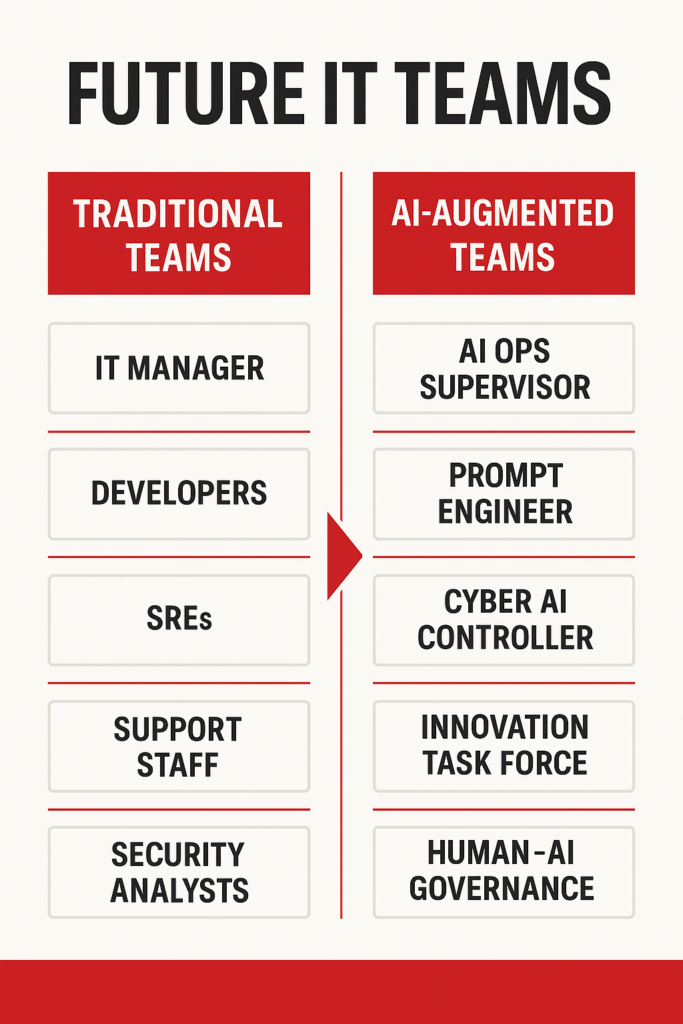
🏢 What IT Teams Will Look Like in 2026
Not 200-person engineering departments.
Not layers of support desks.
But small elite teams like:
| Role | Responsibility |
|---|---|
| AI Ops Supervisor | Oversees agent performance and exceptions |
| Prompt/Playbook Engineer | Writes task flows AI executes |
| Cyber AI Controller | Handles escalations and risk |
| Innovation Task Force | High-level architecture & R&D |
| Human–AI Governance Unit | Ethics, compliance, oversight |
Humans move from task execution → strategy, creativity, exception management.
⚙ How an AI Agent Operated IT Department Works
Imagine this workflow:
- Server load spikes
- AI detects anomaly in logs
- Auto-scales infra
- Runs diagnostic tests
- Sends summary to Slack
- If failure persists → escalates to human
This entire process happens without human involvement.
The role of engineers becomes:
“Approve, supervise, innovate — not operate.”
📌 Real Examples Already in Motion
- Devin AI can autonomously build full applications end-to-end
- Github Copilot handles 60%+ developer code suggestions
- UIPath + LLM agents manage enterprise automation workflows
- AIOps platforms like Dynatrace & Datadog auto-heal systems
- SOC tools containment malware without analyst touch
We’re not predicting the future — we are describing the present.
2026 is when early adopters will outperform laggards by a decade.
⚠ But Will AI Replace Humans Entirely?
No — but it will replace job functions.
The real replacement isn’t “AI vs humans.”
It’s:
People using AI vs people who don’t.
The IT workforce will transform like this:
🔻 Routine operational roles decline
🔺 Strategic, creative, supervisory roles multiply
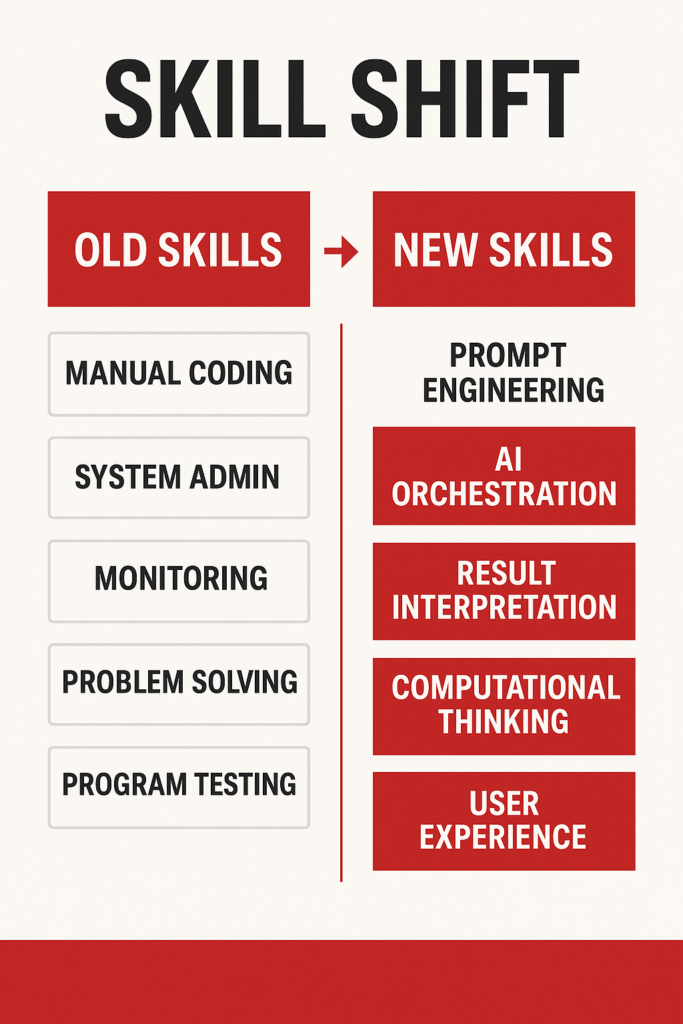
The winners will be professionals who learn:
- AI workflow building
- Prompt engineering
- System orchestration
- Human-in-the-loop governance
🧩 How IT Leaders Should Prepare Today
1. Adopt AI agents gradually
Start with support desk, monitoring, DevOps automation.
2. Build AI skill transformation inside team
Upskill engineers in LLM workflows, automation scripting, reasoning models.
3. Migrate to AI-friendly architecture
APIs, event-driven design, observability pipelines.
4. Create AI governance & risk protocols
Trustworthy AI > fast AI.
5. Shift hiring to hybrid AI-talent profiles
Developers who understand LLMs will be gold.
Future Outlook: The AI-First IT Workplace
By 2026:
- 60–80% of IT tickets resolved by AI agents
- DevOps becomes NoOps (self-operating)
- AI-assisted coding becomes default
- AI security becomes mandatory
- Teams shrink, output grows
- Humans manage exceptions, not routine
Organizations will compete on agent efficiency, not headcount.
AI won’t take jobs from capable professionals — it will take jobs from repetitive work.
Conclusion — A Silent Revolution is Underway
The IT department of the future won’t look like today.
Not because humans disappear — but because humans evolve beyond routine work.
Cybersecurity, DevOps, ITSM, software delivery will run on autonomous intelligence.
It’s not futuristic — it’s inevitable.
2026 won’t be the end of IT jobs.
It will be the end of IT as a human-only workforce.
And the birth of AI-first digital enterprises.